


Pure Titanium Cutting Board (TA1)
One board for every meal — non-porous, won't harbour bacteria, sheds no plastic. The last board you'll buy.




Nowhere for residue to hide
Bacteria and residue have far less to cling to on a smooth, non-porous surface — no cracks, no knife grooves, nothing soaking in the way it does with worn plastic or timber.
Sheds no microplastics
Plastic boards can shed particles into food with every cut. A solid titanium surface sheds nothing.
Built for a lifetime
Won't warp, split, stain or absorb odours. Dishwasher safe, and ready for the next meal.
Kind to your knives
A touch of give that hardened glass and stone boards never offer — your edge stays keener for longer.
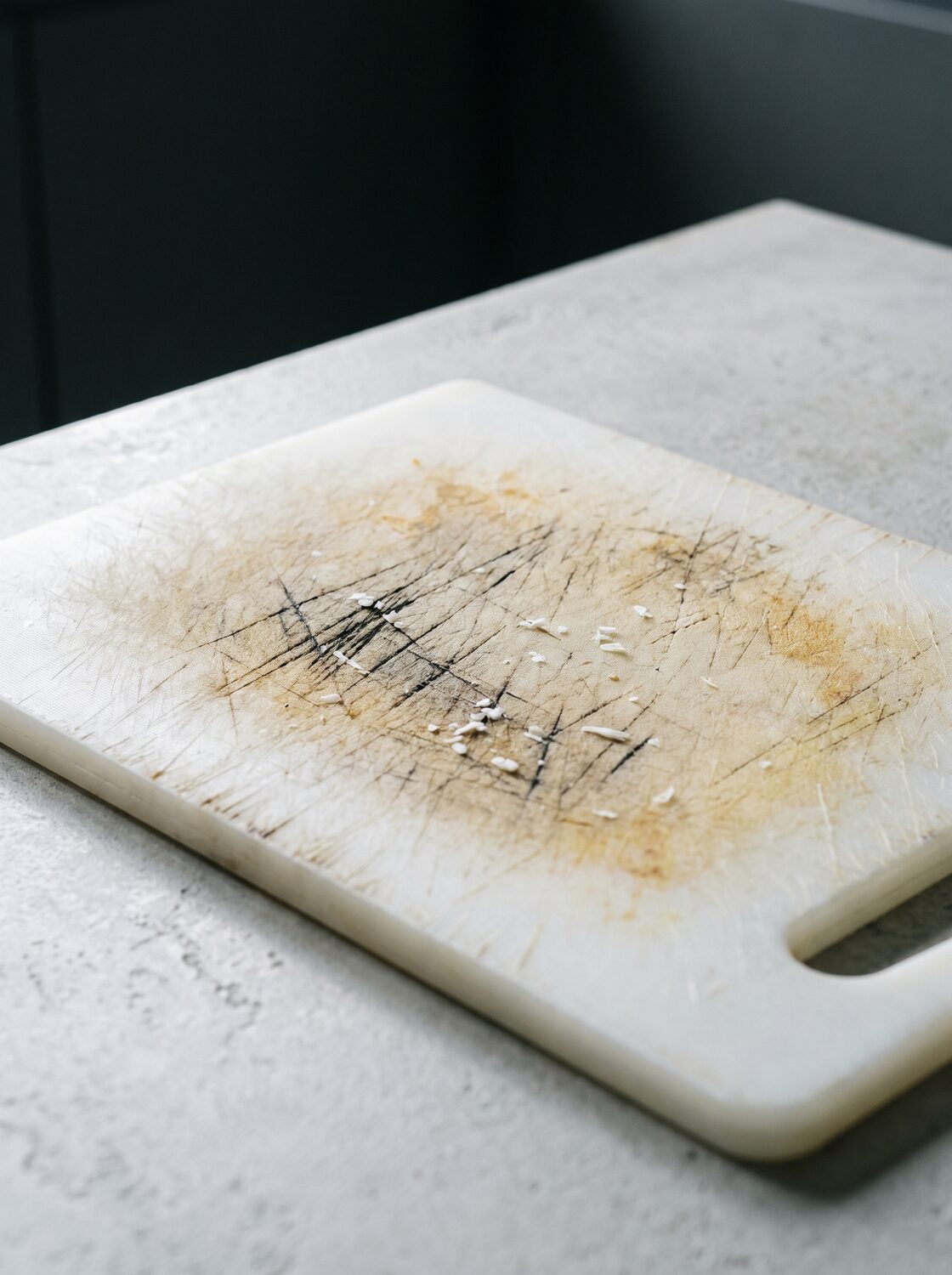
Every cut on a plastic board leaves something behind.
Those knife grooves don't just hold last night's garlic. Peer-reviewed research has documented plastic chopping boards releasing microplastic particles into food during normal use — and the scratches give bacteria a place to settle that a sponge can miss.
Wood draws in moisture and the bacteria that come with it. Composite and "eco" boards are bonded with phenolic resin. We wanted one surface that sidestepped all of it.
A surface that gives food nowhere to hide.
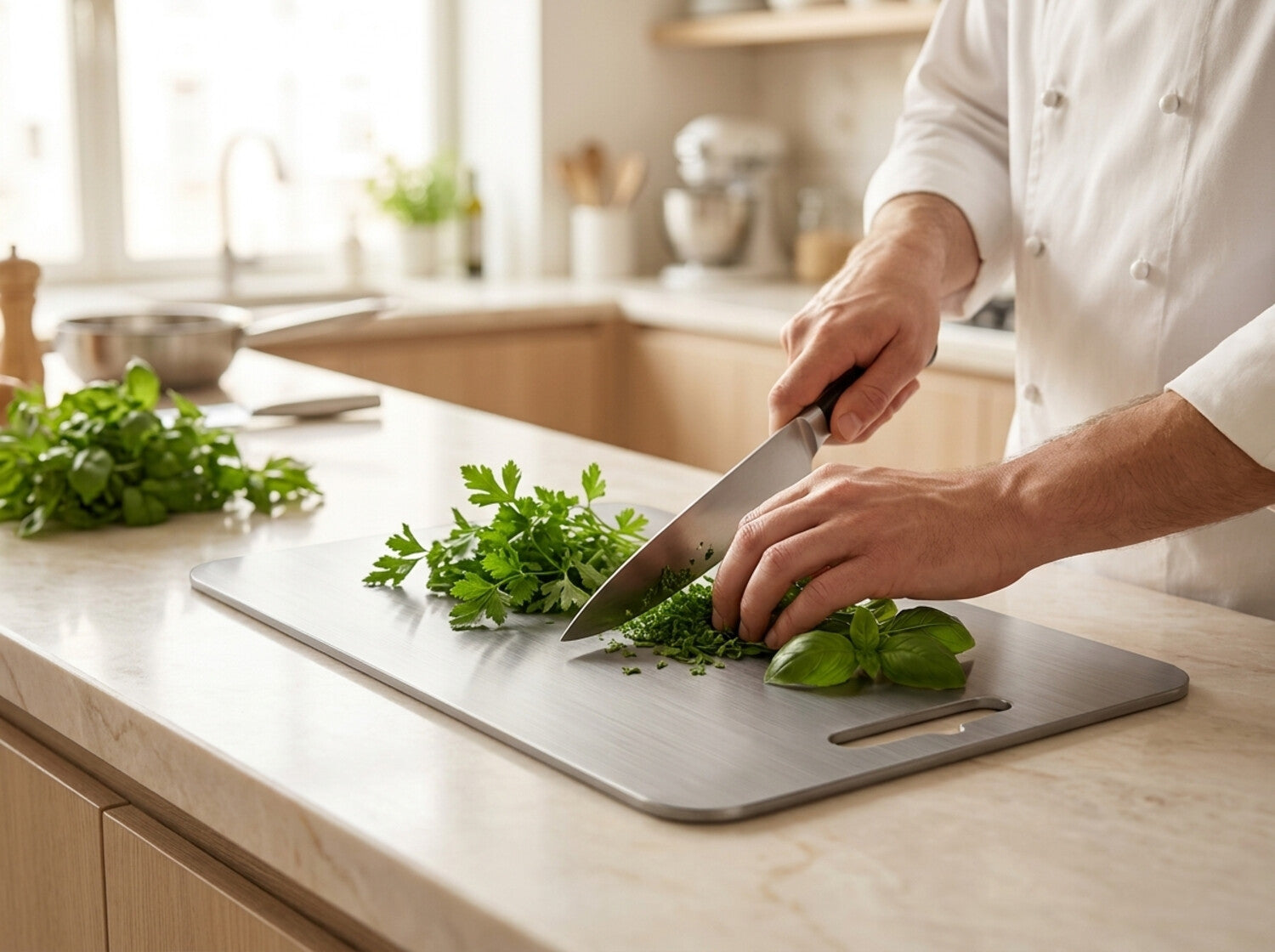
Titanium is non-porous, corrosion-resistant and inert — the same family of metal trusted in demanding medical and aerospace settings. Nothing soaks in. Nothing leaches out.
Rinse it, run it through the dishwasher, set a hot pan straight on it. It won't warp, split, stain or hold a smell. One honest note: titanium (≈150–250 HV) is softer than a hardened knife edge (≈600–700 HV), so fine lines appear with use. We think that's a fair trade for a board that never needs replacing — and it's far kinder to your blade than glass or stone.
How the materials really stack up

- Non-porous, no bacteria traps
- Sheds no microplastics
- Dishwasher & heat safe
- Lasts a lifetime
- Can shed microplastics
- Grooves can harbour bacteria
- Stains & holds odour
- Needs replacing often

- Porous — absorbs moisture
- Can harbour bacteria
- Not dishwasher safe
- Needs regular oiling

- Bonded with phenolic resin
- Can dull knives faster
- Wears at the edges
- Not a forever board

Why we built this
The board I wanted for my own family.
“I’ve got a three-year-old and a newborn, and I cook for them most nights. When I read what an ordinary plastic board sheds into food, I threw ours out that night — and couldn’t find a single board I trusted to replace it.”
Plastic sheds microplastics. Wood harbours bacteria. Even the pretty resin boards can off-gas and scar. So we had this one made: pure titanium (TA1), non-porous, dishwasher-safe. Nothing soaks in, nothing leaches out. It’s the board I wanted for my kids — and now it’s yours.
— Perfect Titanium
Each board is cut from pure titanium (TA1) — chosen because it is inert, non-porous and corrosion-resistant. It isn't coated or plated; the surface you cut on is the metal itself.
| Material | Pure titanium (TA1) |
| Surface | Non-porous, uncoated, food-contact |
| Sizes | Prep 29×20cm · Everyday 36×25cm · Family 46×30cm |
| Thickness | 0.15 cm (Everyday) · 0.2 cm (Pro) |
| Care | Dishwasher safe · heat resistant |
Day to day: rinse under the tap or drop it in the dishwasher — no oiling, no special soap, no drying ritual. It won't warp, split or hold a smell.
Heat: titanium shrugs off heat, so a hot pan straight from the stove won't mark it.
On knife marks: titanium (≈150–250 HV) is softer than a hardened blade (≈600–700 HV), so you'll see fine lines develop with use. This is normal and expected — a sign the surface is working with your knife, not against it. It is not a fault, and the board performs exactly the same.
Microplastics: peer-reviewed research has documented plastic chopping boards releasing microplastic particles into food during normal use. A non-porous metal surface removes that pathway.
Bacteria: porous and deeply-scored surfaces give bacteria somewhere to settle that cleaning can miss. Titanium's non-porous surface leaves nowhere to hide.
We only tell you what we can stand behind. Where we make a claim about health or materials, it's grounded in published research — and where titanium has a trade-off, like knife marks, we say so plainly.
See it in everyday use
Answered, honestly
Yes — fine lines appear over time. Titanium (≈150–250 HV) is softer than a hardened knife edge (≈600–700 HV), so marks are normal and expected. They don't affect performance or hygiene, and the non-porous surface stays just as easy to clean. We'd rather be upfront than promise a "scratch-proof" board that doesn't exist.
Titanium has a slight give that's kinder to your edge than glass, stone or bamboo. Many cooks pair the board with our diamond + ceramic sharpener to keep every blade in top form.
Completely. It won't warp, split, rust or hold odours — rinse it or run it through the dishwasher after raw meat with no second thoughts.
Prep (29×20cm) for quick jobs and small kitchens. Everyday (36×25cm) is our most popular all-rounder. Family (46×30cm) gives room for a full roast or batch cooking. Many people choose a two- or three-board set to keep raw and ready foods separate.
Every order is dispatched directly from our manufacturer. As soon as your board is on its way, we'll email you a shipping confirmation with a live tracking link so you can follow the parcel from door to door.